
What is clinical trial financial management?
Clinical trial financial management involves budgeting, forecasting, tracking, and analyzing trial costs alongside operational progress, including patient enrollment, site activity, and study milestones. By connecting spending to what’s actually happening in a trial, companies can better understand financial performance, update forecasts, and anticipate future capital needs.
Your Clinical-Trial Budget Looks Fine. So Why Are You Sweating?
Your company has a clinical trial underway. You’ve built a budget, mapped out expected costs, and started tracking invoices. Spending is close to plan. Nobody’s sending panicked emails. Maybe you even have time to finish your coffee while it’s still hot.
Then someone mentions that patient enrollment is behind schedule.
Suddenly, being on budget doesn’t feel quite as reassuring. You’re spending money, but is the trial progressing as expected? And if things keep moving at this pace, what does that mean for your cash needs six months from now?
One of the trickier parts of clinical trial financial management is that spending money and making progress don’t always happen on the same timeline.
Clinical trials involve investigator fees, site costs, contract research organization (CRO) invoices, supplies, and plenty of other expenses. Those costs don’t necessarily line up neatly with patient recruitment or study milestones.
Why Clinical Trial Budgets Can Look Fine Even When the Trial Isn’t
Every clinical trial budget starts with assumptions. You estimate when sites will be activated, how quickly patients will enroll, what vendors will charge, and how long the trial will take.
Those assumptions give you a plan, not a crystal ball.
Once the trial gets moving, reality starts making edits. Enrollment can stall, sites may become active at different times, and vendor invoices could arrive in batches instead of showing up like clockwork.
None of this necessarily means something has gone wrong. But it does mean the original clinical trial budgeting may not tell the whole story.
Imagine your spending is almost exactly where the budget says it should be. At first glance, that’s reassuring.
But if patient enrollment is lagging, you may be spending according to plan without making the progress you expected.
Now flip the scenario. Spending is higher than planned, but enrollment is moving faster than expected. That variance might not be a red flag.
Same report. Different realities.
Leadership needs more than a green checkmark next to the budget. It needs context into what’s driving numbers, possible timing issues, and whether expected costs have changed.
Connect Clinical Trial Spending to Patient Progress
Here’s where clinical trial financial management gets much more useful: connect the financial picture to what’s happening operationally. Depending on the study, you’ll look at spending alongside:
- Patient recruitment and enrollment
- Site activation
- Investigator and site activity
- CRO activity
- Study milestones
- Supplies and other expenses
The right measures depend on the trial. There’s no universal dashboard that works for every company, and adding more spreadsheets won’t necessarily give leadership better visibility.
The point is to help leadership understand what’s driving spending.
We saw this challenge with a healthcare client that needed to reconcile historical invoices against patient recruitment because payments weren’t consistently aligned with enrollment progress.
The issue wasn’t just figuring out how much had been paid. The team needed to connect those payments with what was happening with recruitment.
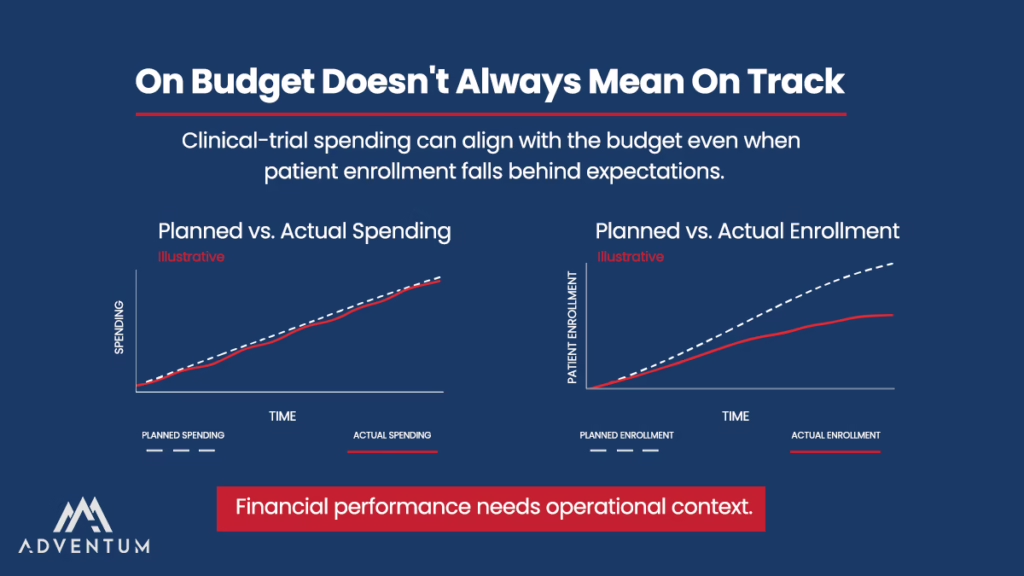
Budget vs. Actual Isn’t Enough
Most finance teams can tell you whether spending is above or below budget. That’s important. But it’s a little like checking your car’s dashboard and seeing a warning light without knowing what it means.
You have information. You don’t always have an answer.
A clinical-trial variance report might show that expenses are higher than expected. But did clinical trial costs increase? Did invoices arrive early? Is the trial progressing faster? Or are expenses continuing while enrollment falls behind?
When reviewing trial costs, leadership should be able to assess:
- Timing differences vs. a genuine change in expected costs
- Whether spending is ahead because trial activity is progressing faster
- If the expected cost of completing the trial has changed
- What the latest information means for future cash requirements
A report can be perfectly accurate and still leave leadership wondering what to do next. If your team can identify a variance but can’t explain what’s driving it, there’s still a piece missing.
Clinical Trial Forecasting Should Change as the Trial Changes
Your original budget was built using the information available at the time. As enrollment progresses, invoices come in, and timelines become clearer, you get new information.
Your forecast should use it.
That doesn’t mean rebuilding the entire financial model every time an invoice hits your inbox. Nobody has time for that. It means regularly revisiting the assumptions that most affect costs and timing.
If recruitment is slower than expected, you may need to reassess enrollment assumptions, site timelines, vendor spending, and the expected remaining duration of the trial. If sites become active earlier or later than planned, the timing of related costs may change, too.
A useful forecast estimates what the company is likely to spend from this point forward.
A rolling forecast is helpful in these situations. Instead of treating the original budget like it’s carved in stone, you update your outlook as results and revised assumptions become available.
You should be able to recognize when assumptions change, understand the financial impact, and adjust the financial forecast accordingly.
Why Trial Economics Matter to the Company’s Broader Cash Plan
A trial’s costs and timeline don’t affect just the trial. The financial implications of a delay add up quickly and can ripple through the entire company.
Research from the Tufts Center for the Study of Drug Development estimated the direct daily cost of conducting a Phase II or Phase III clinical trial at approximately $40,000. That doesn’t mean every additional day adds tens of thousands in costs, but it shows why changes to a study’s timeline deserve a fresh look at the forecast.
Leadership needs a realistic picture of how much cash the business will need, and when.
Clinical trial financial management should connect to the company’s broader cash plan. Your trial forecast shouldn’t live in a lonely spreadsheet that only one person understands.
Ask yourself: If the trial takes longer, how does that affect our runway? If costs increase, what spending plans might need to change? If the next milestone moves, will we still have enough capital to reach it?
These aren’t just finance-team questions. They’re business decisions with consequences for startup cash burn and financial planning.
Build Scenarios Before the Trial Forces the Decision
No one wants to discover a cash shortfall when there’s barely enough time to respond. Do scenario planning long before a change forces the conversation. Start with a few “what-if ” scenarios:
- What if enrollment takes longer than expected?
- What if trial costs increase?
- What if the timeline extends by several months?
- What if additional capital is needed before the next milestone?
This doesn’t need to become a 200-tab spreadsheet with 14 possible futures. Start with the scenarios most likely to affect your financial decisions.
Scenario planning isn’t about assuming the worst. It’s about understanding what could happen and giving leadership time to evaluate its options before a decision becomes urgent.
When Clinical Trial Finance Needs More Than Bookkeeping
Bookkeeping and clinical trial accrual accounting are essential. Someone needs to ensure expenses are recorded accurately, and invoices don’t disappear into the administrative abyss.
But recording what happened and forecasting what happens next are two different jobs.
As clinical development becomes a significant part of a company’s spending, leadership may need a more strategic layer of financial planning. A few signs it’s time to take a closer look include:
- Trial expenses are difficult to reconcile against patient recruitment or study progress.
- Leadership can’t confidently estimate the trial’s remaining cost.
- Budget variances appear, but their causes aren’t clear.
- Cash forecasts don’t reflect changing enrollment or clinical trial accruals timelines.
- Modeling the financial impact of a delay requires significant manual work.
- Board or investor questions about trial spending and future capital needs take too long to answer.
These challenges don’t necessarily mean you need to hire an entire finance department. They may just reveal your existing finance function needs a better way to connect accounting and operational information with forward-looking planning.
Leadership doesn’t just need to know where the money went. It needs to understand what today’s information means for tomorrow’s decisions.
Better Clinical Trial Financial Management Starts With Better Visibility
Clinical trial cost management shouldn’t stop at checking whether invoices match a static budget. It should connect the dots:
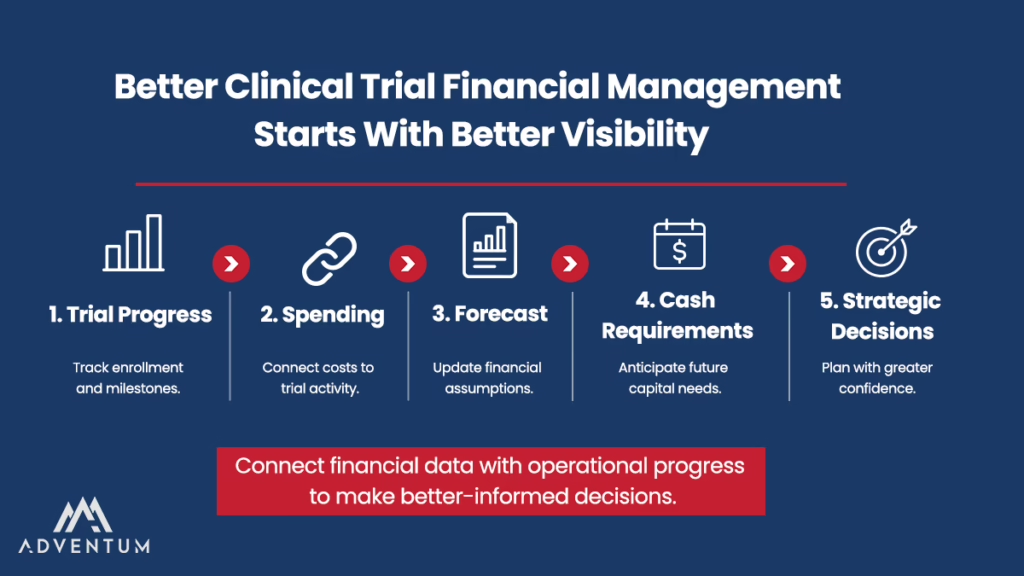
When those pieces work together, leadership can spot changing assumptions earlier, understand the potential cost of different outcomes, and plan for future capital needs with greater confidence.
A clinical-trial budget can look fine while the economics underneath it are changing. The answer isn’t another report or a more complicated spreadsheet. It’s a clearer understanding of how spending relates to progress, and what that relationship means for the business.
Getting a clearer picture of trial spending is only part of the challenge. As healthcare companies move closer to commercialization, those same financial assumptions become the foundation for another set of decisions: how to fund the next stage of growth.