
Finance strategy can break down as businesses grow because new markets, revenue streams, investors, and reporting requirements create complications that traditional processes aren’t designed to handle. Complex business finance requires strategic financial planning, reliable forecasting, and clear financial visibility so leadership can make faster, more confident decisions as the company scales.
Launching a business sounds simple enough, right? Get customers, make money, hire good people, and keep the momentum going.
And for a while, things can feel pretty straightforward.
Then the business grows. You add another location, drop a new product, and bring on investors. There are now three different revenue streams, more stakeholders asking for financial reports, and far more spreadsheets than anyone planned for.
Suddenly, the finance functions that used to feel manageable start feeling increasingly difficult to manage. There are more reports, spreadsheets, people asking questions, and tons of moving parts to keep track of.
A business can go from simple to complicated almost overnight.
The good news? Complex business finance isn’t necessarily a bad thing. In fact, it’s often a sign of success. The trick is making sure your finance function scales with your company.
Why Does Finance Strategy Get Harder as a Business Gets More Complex?
The short answer is that there are more things to understand, connect, track, and explain.
As businesses become more complex:
- More stakeholders require better financial visibility.
- Multiple products or revenue streams make forecasting harder.
- Manual processes become slower and error-prone.
- Leadership needs financial information that helps them make decisions.
Nobody wants to make finance more complicated than it has to be. Your aim is to make the company easier to understand, even as the underlying operation becomes more elaborate.
Growth Doesn’t Create Finance Problems. Complexity Does.
It’s easy to assume that a company with $50 million in revenue needs a much more sophisticated finance function than a company with $5 million simply because it’s bigger.
Surprisingly though, revenue doesn’t always determine finance complexity.
Consider two companies with the same revenue. One operates in a single market, sells one primary service, has one legal entity, and has a relatively predictable customer base. The other operates internationally, has multiple entities, several product lines, different revenue models, and outside investors.
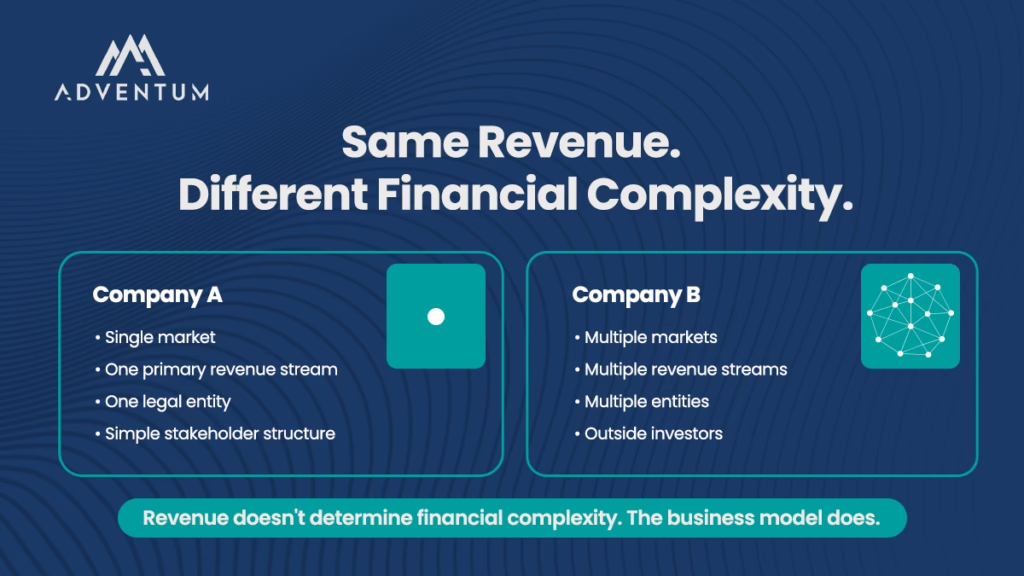
Their finance needs are going to be totally different. Complexity tends to increase when businesses:
- Expand into new geographic markets
- Add locations or legal entities
- Introduce new products or services
- Acquire another company
- Develop multiple revenue streams
- Take on outside investors
- Add board members or institutional stakeholders
- Build larger and more specialized teams
At this point, leadership doesn’t just need to know whether revenue went up or down. They need to know why.
Which business line is driving growth? Which customers are most profitable? Where are margins changing? What will our cash burn be six months from now? Can the company afford the acquisition it’s considering?
These strategic questions require a finance function that can do more than record transactions.
Why Traditional Finance Processes Stop Working
Here’s something we’ve learned from working with growing companies: the systems that got you here may not be the systems that get you where you want to go.
That’s not a criticism. It’s normal.
A spreadsheet can be exactly the right solution when a business is small and one person manages most of the financial reporting.
That risk becomes even more important when spreadsheets are being used to support significant business decisions
As businesses become more complex, we often see several red flags indicating that finance processes haven’t caught up.
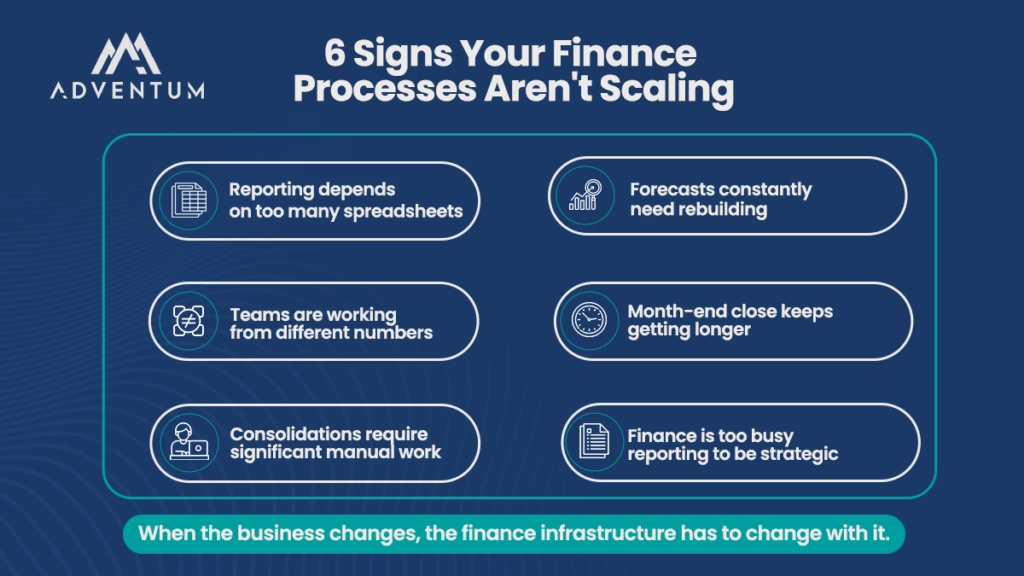
- Spreadsheet-Driven Reporting: Spreadsheets are incredibly useful, but they become risky when essential financial information depends on manual updates across multiple files. Even more terrifying, 94% of spreadsheets used in decision-making have critical errors.
- Multiple Versions of Truth: Sales has one number. Finance has another. Operations has a third. Now the leadership meeting is spent figuring out which number is correct instead of discussing what to do about it.
- Manual Consolidations: Combining information from multiple entities, locations, or systems creates additional work and potential mistakes.
- Constantly Changing Forecasts: Forecasts should change when the business changes. But if the forecast has to be rebuilt from scratch every time something moves, you’ve got a process problem.
- Longer Month-End Closes: As transaction volume and financial reporting requirements increase, an outdated close process can consume more and more time. Eventually, leadership is still reviewing last month’s results while this month’s business is already moving ahead.
- Finance Isn’t Strategic: This is the biggest warning sign. Your finance team is working constantly, but leadership still doesn’t have the answers it needs. People are reconciling accounts and answering data questions, but there’s little time left to analyze trends or help the business plan its next move.
This doesn’t mean your company has failed at finance. They’re signs that the business has changed. And change is a good thing!
But remember, the systems and processes that worked at one stage simply weren’t designed for the next one.
Complex Business Finance Requires Strategic Finance, Not More Accounting
When finance starts struggling under the weight of business complexity, your go-to response might be to add another accountant, another analyst, or another reporting process.
Sometimes that’s exactly what’s needed.
But sometimes the business doesn’t need more finance. It needs better finance.
Traditional accounting answers important questions like: What happened? What did we spend? What do we owe? What did we earn?
Strategic finance takes it a step further, asking: Why did it happen? What happens next? What if we change this? Can we afford that? Where should we invest? What’s creating the most value?

Instead of looking at financial data in isolation, strategic finance connects it to what’s happening in the business. Revenue might be growing 20%, for example, but what if headcount is growing 35%? What if accounts receivable is growing faster than revenue?
All of a sudden, that 20% growth doesn’t tell you nearly enough.
Strategic finance helps connect those dots and gives leadership the context behind the numbers. It can help you:
- Build more reliable forecasts
- Connect operational and financial performance
- Create valuable KPIs
- Improve cash flow visibility
- Identify risks earlier
And this is where finance becomes a super powerful decision-making tool.
We recently worked with a technology company that was trying to decide whether to pursue an acquisition to accelerate growth and improve its eventual exit value. The acquisition looked strong on paper, but a deeper analysis revealed the target was near break-even and faced costs and customer-retention risks.
Our team helped leadership weigh the deal against organic growth and evaluate financing options. The key takeaway here is that good acquisitions require looking at much more than revenue and margins to understand the full financial and strategic scope.
Industries That Make Finance Complexity More Complicated
Every growing business eventually faces more complicated financial decisions. Some industries add another layer of financial complexity.
Health-tech is the first that comes to mind.
A growing health-tech company may have to balance regulatory requirements, compliance, complicated revenue models, long sales cycles, product development costs, and investor expectations, all while trying to build and sell a product.
Whew…that’s a lot to put on one financial model.
Other industries have their own versions of the same challenge. Complexity can increase when a company has:
- Significant regulatory or compliance requirements
- Long or unpredictable sales cycles
- Specialized operating models
- Large capital requirements
- Complicated reimbursement or payment structures
- Significant investor or board reporting requirements
A cookie-cutter approach to finance eventually falls flat.
The finance strategy that works for a straightforward professional services company may not work for a health-tech company. A reporting structure designed for one location may be completely inadequate for a business operating across 30.
Finance must always reflect the business.
That’s also why we’re taking a closer look at finance strategy through the lens of specific complex industries in upcoming content, including the unique challenges companies face as they grow, raise capital, and navigate increasingly complicated operating environments. We’ll explore those challenges more closely in upcoming content.
Your Business Got More Complicated. Did Your Finance Strategy?
The funny thing about business complexity is it’s usually a good problem to have.
If you’ve launched products, entered new markets, attracted investors, or acquired another business, you’re probably doing something right.
But success creates responsibility.
The finance function that worked when the company was smaller may eventually become a bottleneck. Not because anyone did anything wrong, but because the business simply isn’t the same business anymore.
It’s worth asking:
- Can leadership get reliable financial information quickly?
- Does everyone work from the same numbers?
- Can we explain what’s driving performance?
- Can we confidently forecast what happens next?
- Can we model major decisions before making them?
If any one of those questions makes you pause, your company may have outgrown its current finance strategy.
The goal of complex business finance isn’t to eliminate complexity. That’s probably impossible. And if you’re growing, you probably don’t want to.
However, you do want to create enough financial visibility and structure that complexity doesn’t prevent you from moving forward.
When finance keeps pace with the business, complicated information starts becoming clear.