
What is portfolio company efficiency?
Portfolio company efficiency is the ability of a business to use its people, capital, systems, and financial processes effectively to maximize growth, profitability, and enterprise value. Efficient companies make faster decisions, allocate resources wisely, and create greater long-term value for investors and stakeholders.
When you’re evaluating a portfolio company, it’s easy to focus on the big numbers, like revenue and growth.
Those things matter, but they don’t always tell you what’s going on inside the business.
Some of the top drivers of enterprise value are buried deep in daily operations, like how fast leadership makes decisions or whether cash is working as hard as employees do.
The funny thing is, a company can be growing fast while all sorts of inefficiencies are piling up in the dark, unused corners of the office. Sales are steady, customers are happy, and everything looks peachy keen…until it doesn’t.
Eventually those little issues turn into big setbacks. Reporting slows down, forecasts become less reliable, and decisions seem to happen slower than a turtle race. And suddenly growth isn’t quite as smooth as it used to be.
We’ve spent this Investor’s Edge series talking about strategic finance. Better reporting, clearer forecasting, protecting LP value, and stronger cash management are all pieces of the same puzzle. They help companies operate more efficiently, make smarter decisions, and generate value.
These problems almost never come out of nowhere. They leave clues. And once you know where to look, they’re surprisingly easy to spot.
Strong Companies Can Still Have Hidden Inefficiencies
Here’s something we’ve seen a million times. Just because a company is growing doesn’t mean it’s running efficiently.
When demand is high, and new customers are coming in, everyone is working double-time to keep up. Hiring people, expanding into markets, and launching shiny new products.
Nobody’s saying, “Hey, maybe we should rethink our reporting process.”
And honestly, they shouldn’t be.
Eventually, however, growth begins putting pressure on every part of the business. Finance teams take longer to close the books, execs wait longer for reports, and board meetings become endless conversations about numbers instead of strategy.
None of this necessarily points to poor leadership. Quite the opposite. Most management teams are too entrenched in the day-to-day operation to recognize inefficiencies that have become part of business as usual.
Investors often notice patterns before management does because they have the advantage of a bird’s-eye perspective. Some of the most common red flags include:
- Forecasts that miss expectations
- Reporting that takes weeks instead of days
- Cash gridlocked in working capital longer than necessary
- Finance teams overwhelmed by manual reporting
- Leadership delaying important decisions because reliable information isn’t readily available

While each issue may seem small on its own, together they reveal how efficiently, or inefficiently, a business is operating.
One of the clearest windows into portfolio company performance is found in the quality, consistency, and visibility of the business’s financial information.
Five Places Investors Consistently Find Inefficiencies
1. Forecasts That Rarely Match Reality
Nobody expects forecasts to be perfect.
We’re only humans after all, not clairvoyants.
Markets change, customers behave unpredictably, and unexpected events happen. What matters is whether forecasts continually help leadership make better decisions.
When projections routinely miss the mark, investors start asking more questions. Are revenue assumptions overly optimistic? Are department leaders communicating effectively? Are expense forecasts updated frequently enough?
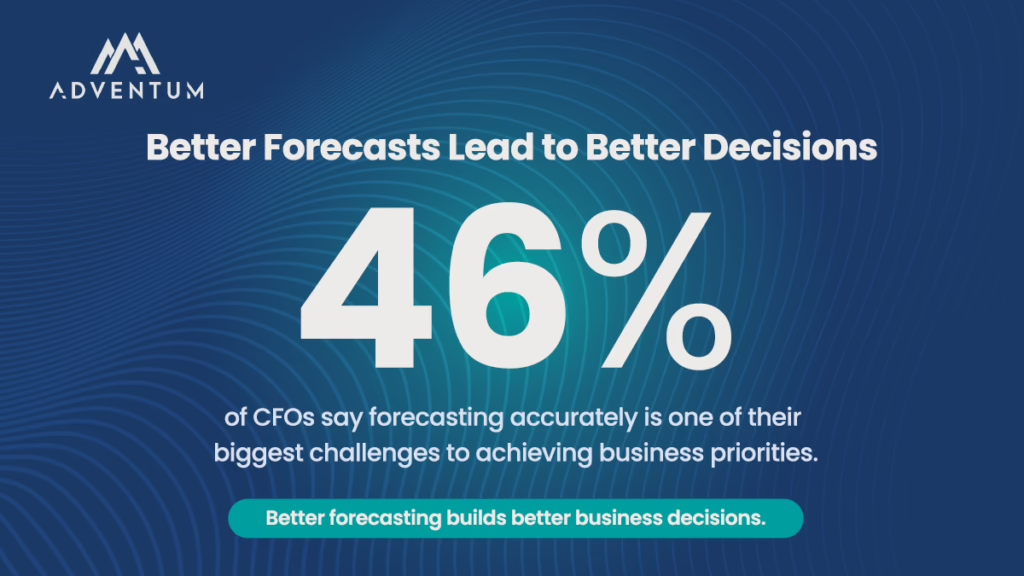
Inaccurate forecasts can point to operational issues that extend far beyond the finance department. Sales may not be sharing pipeline updates in real time. Hiring plans may shift without affecting financial projections. Or, business conditions may evolve faster than planning processes. In fact, 46% of CFOs say forecasting accurately is one of their biggest challenges to achieving business priorities.
Transitioning to rolling forecasts often gives both executives and investors a better understanding of what’s happening in the business today, not what they expected six months ago.
Reliable financial forecasting creates confidence because everyone, from department leaders to board members, makes decisions based on the same realistic expectations.
2. Cash That Isn’t Working Efficiently
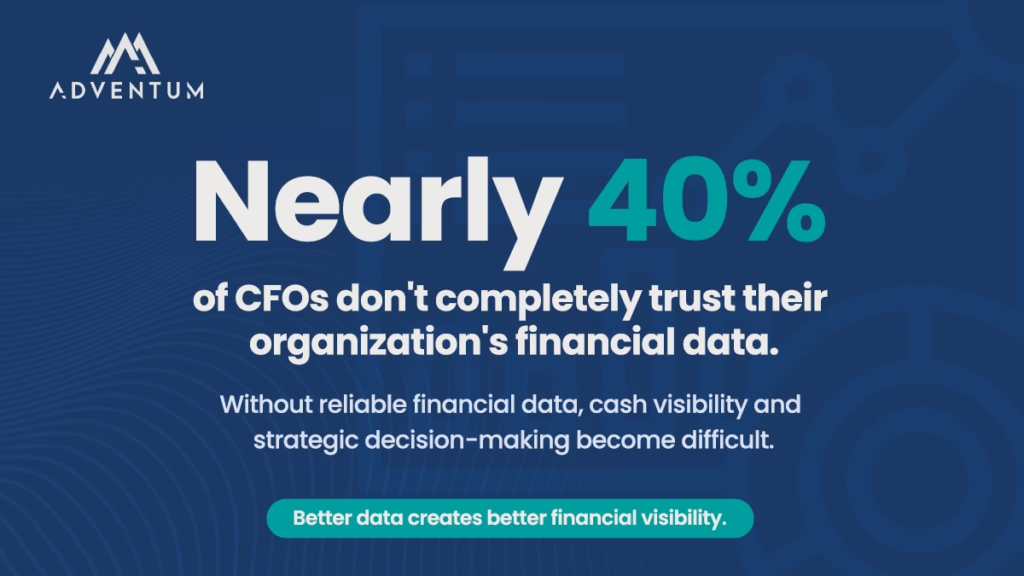
Healthy revenue doesn’t always equate healthy cash flow. Nearly 40% of CFOs don’t completely trust their organization’s financial data, making cash visibility and strategic decision-making difficult.
Many portfolio companies appear financially strong on paper while creating unnecessary pressure on working capital. Receivables may linger longer than expected, or inventory might grow faster than demand.
While none of these situations should be immediate cause for concern, they can hinder flexibility.
Every dollar stalled unnecessarily is one less dollar available to invest in hiring, acquisitions, technology, product development, or strategic opportunities.
Investors often examine cash management by asking questions like:
- How quickly are receivables being collected?
- Is inventory aligned with demand?
- Are payment cycles optimized?
- Does leadership have clear visibility into future cash needs?
- Are working capital trends improving or gradually worsening?
We’ve seen this play out firsthand. One fast-growing medical products company looked like it was doing everything right. The business had sold about $12 million worth of product.
The only problem was that about $1.9 million of that money had made it into the bank.
Nearly $10 million was snagged up in unpaid invoices, many of them more than six months old. The company wasn’t struggling to make sales. It was struggling to collect on them. As the business grew, its commercial partner’s billing and collections process hadn’t kept up.
On paper, everything looked great. Behind the scenes, though, cash was sitting on the sidelines instead of fueling the business.
3. Reporting That Arrives Too Late
Just like milk, financial reports have an expiration date. The longer they take to be created, the less useful they become. Luckily though, old reports won’t stink up your fridge.
But when people don’t have the information they need, they might start creating it themselves.
That’s a tough way to run a business, and causes finance teams to spend vast amounts of time answering questions that could have been avoided with standardized reporting and KPIs.
4. Manual Processes That Don’t Scale
Most companies begin with spreadsheets.
There’s nothing wrong with that. In the early stages, spreadsheets are affordable and familiar.
The problem arises when those same processes continue supporting a business that has doubled, tripled, or even quadrupled in size.
Finance professionals can find themselves manually consolidating reports, updating board presentations, copying information between systems, or maintaining complex spreadsheets that only one person truly understands.
Eventually, these manual processes become huge operational bottlenecks.
This happens to one growing company we worked with. Every month, the finance team manually exported trial balances, copied and pasted data between systems, and updated spreadsheets by hand. Their most important metrics lived in one massive spreadsheet that only one person really knew how to use. On top of that, board reports were often as much as 60 days behind.
We helped simplify the process by consolidating the entities, automating the flow of financial data into reporting, and rebuilding the financial model. Instead of scrambling every month to prepare board reports, leadership had timely, accurate numbers they could actually use to make decisions.
5. Decisions That Take Too Long
The cost of waiting definitely takes its toll on scaling businesses.
When leadership lacks reliable financial information, important decisions often remain on hold. Expansion plans slow, hiring gets delayed, and investment opportunities pass by.
Those delays carry real costs, even if they never appear on a financial statement.
Markets evolve quickly, customer expectations shift, and competitors are always waiting to get the upper hand. So you better be acting fast.
Why Small Inefficiencies Become Expensive
Hidden inefficiencies rarely stem from one major problem. Instead, they develop through dozens of seemingly insignificant issues that accumulate over time.
A reporting process that takes an extra two days. Forecast assumptions that aren’t updated frequently enough. Finance teams spending hours consolidating spreadsheets every month. Cash sitting in receivables longer than necessary.
Individually, each issue feels manageable. Collectively, they consume executive time, reduce profitability, slow decision-making, and affect business value.
These costs often appear in ways that are difficult to measure directly:
- Leadership spends more time gathering information than making decisions
- Finance teams focus on manual tasks instead of strategic analysis
- Investors receive delayed insights into emerging risks
- Operational complexity increases faster than financial visibility
The businesses that flourish identify and eliminate these bottlenecks before they become embedded in the company’s daily operations.
What Strategic Finance Helps Fix
Strategic finance is an operating advantage that improves how the entire business functions. When financial systems, reporting processes, forecasting, and KPI visibility work together, organizations can:
- Build more accurate financial forecasting
- Standardize reporting across departments and portfolio companies
- Improve visibility into the KPIs that drive performance
- Strengthen cash flow planning and working capital management
- Deliver faster, more insightful board reporting
- Make better business decisions with greater speed and confidence

Throughout this Investor’s Edge series, one theme has remained consistent: finance should never be viewed as a back-office function. It should serve as one of the organization’s most valuable strategic assets, providing the insights that help investors and leadership teams navigate growth with clarity and confidence.
Frequently Asked Questions
What is portfolio company efficiency?
Portfolio company operational efficiency measures how effectively a company uses its people, systems, capital, and financial processes to maximize profitability, growth, and enterprise value while minimizing operational friction.
Why is portfolio company efficiency important to investors?
Efficient businesses typically generate stronger financial performance, make faster decisions, manage risk more effectively, and create greater long-term value, making them more attractive investments.
How can investors identify hidden inefficiencies?
Investors should look beyond financial statements by evaluating forecasting accuracy, cash flow visibility, reporting consistency, KPI alignment, finance processes, and decision-making speed. These areas often reveal operational issues before they significantly affect performance.
How does strategic finance improve portfolio company efficiency?
Strategic finance improves efficiency by creating better forecasts, standardized reporting, stronger cash flow planning, improved KPI visibility, faster board reporting, and more informed business decisions that help leadership respond quickly to changing conditions.
Looking Beyond the Numbers
As we close this Investor’s Edge series, one lesson stands above the rest: the best investors look for the operational patterns that determine future performance.
Strong portfolio company efficiency gives leadership teams the financial visibility and confidence they need to run stronger businesses.
Strategic finance connects reporting, forecasting, cash flow management, and operational insight into a single foundation for smarter decisions. When investors and leadership teams have that groundwork, they can unlock sustainable growth, not just for one company, but across an entire portfolio.
It’s a fitting conclusion to this series because it brings together everything we’ve discussed along the way. Better reporting builds trust. Accurate forecasting improves planning. Greater financial visibility reduces risk. Together, they deliver lasting value for everyone invested in the journey.