
What Are CFO Services for Series B Fundraising?
CFO services for Series B fundraising provide strategic financial leadership that prepares a startup for the scrutiny of growth-stage investors. This includes rebuilding financial models into driver-based systems, normalizing historical financials, strengthening reporting discipline, and aligning capital strategy with scalable growth. The objective is to improve forecast defensibility, capital efficiency, and valuation credibility ahead of a Series B raise.
There’s a moment in every founder’s journey when the energy shifts. Series A is fueled by drive, narrative, and belief. You proved there’s a market, revenue is growing, and investors are backing your potential. But Series B is often steadier, heavier, and more exacting.
By the time you begin considering Series B fundraising CFO services, investors are underwriting predictability. They want to see that revenue is repeatable, margins are improving, customer acquisition is disciplined, and your forecasts hold up under scrutiny. The story still matters, but now it must be supported by structure.
In SaaS and healthcare businesses, especially, the shift can feel abrupt. The metrics that once signaled traction now become value drivers. At this stage, Series B fundraising is less about adding polish and more about reinforcing the foundation beneath your company.

What Actually Changes Between Series A and Series B Fundraising?
The transition from Series A to Series B is about meeting a higher standard of operational evidence. Investors at Series A are often comfortable with directional metrics and early signals of traction. By Series B, that tolerance narrows. Investors don’t just expect growth; they also demand proven paths toward profitability and controlled spending. They often look for ARR north of $10 million, double-digit net retention, and CAC payback under 18 months, clear signs of scalable unit economics.
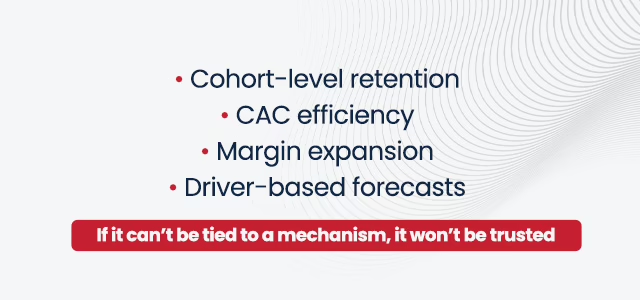
Retention becomes more granular. Blended churn rates that once seemed acceptable are no longer sufficient. Investors want to understand how specific customer cohorts behave over time, how expansion revenue develops, where contraction occurs, and how long-term value evolves across segments.
Customer acquisition cost also faces a more rigorous review. It’s no longer enough to show that growth is happening. Founders must demonstrate that growth is efficient. CAC must reconcile with sales productivity, marketing channel performance, and payback periods. Investors examine whether new capital will generate incremental return or merely accelerate burn.
Contribution margin visibility is also essential. Growth that erodes margin raises concern. At Series B, revenue is evaluated alongside gross margin expansion, service delivery efficiency, and operating leverage potential. Investors want to see that the business becomes structurally stronger as it scales.
Forecast defensibility is one of the most significant changes. Early-stage projections often hinge heavily on ambition. By Series B, projections must connect directly to historical conversion rates, pipeline velocity, hiring ramp times, and retention behavior.
Additionally, reporting discipline must mature. Monthly board packages should follow a consistent structure. Startup financial KPIs should remain stable. Financial narratives should be cohesive across reporting periods.
With only about half of Series A startups making it to Series B, it’s imperative to build the right systems.
Where Series B Diligence Typically Breaks Down
Patterns emerge when companies approach Series B without fully institutionalizing their finance function. Strong growth stories can begin to unravel under closer scrutiny because financial systems haven’t kept pace with operational velocity.
Across post-seed companies, common breakdowns include blended retention figures that mask underlying cohort behavior, forecasts built around aspirational targets rather than measurable drivers, and revenue recognition practices that lack consistency across reporting periods. Sometimes the issue is not incorrect data but shifting definitions, metrics that subtly change month to month, creating confusion when investors attempt to reconcile trends.
Downside scenario modeling is another frequent gap. Investors want to know how the company performs in slower-growth or constrained capital conditions. Without modeled deceleration scenarios, confidence weakens.
For SaaS businesses, inconsistent cohort tracking or miscalculated net revenue retention can quickly undermine valuation credibility. In healthcare, reimbursement timing and regulatory accounting nuances often surface during diligence.
These issues rarely destroy a deal outright. Instead, they introduce friction, lengthen timelines, increase scrutiny, and can compress valuation.
What Strategic CFO Services Actually Implement Before a Series B Raise
Preparing for Series B fundraising requires rebuilding infrastructure. Financial readiness for Series B requires deliberate restructuring of models, reporting systems, and capital strategy.
Engaging strategic CFO services or growth-stage CFO support at this stage is about installing an architectural discipline. Financial systems must be designed so investors can underwrite with confidence.
Implement a Driver-Based Financial Model Investors Can Underwrite
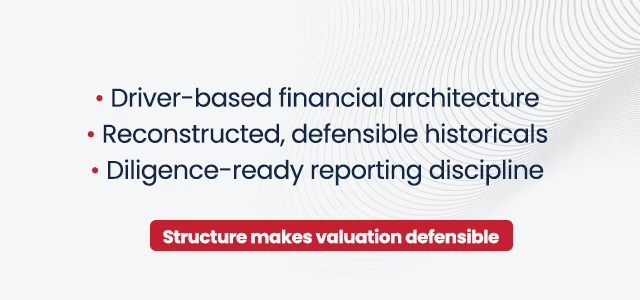
One of the first changes involves replacing static projection spreadsheets with driver-based financial models. In most Series B preparations, early projections are rebuilt into systems tied directly to historical sales capacity, conversion rates, and retention patterns.
Revenue forecasts become grounded in measurable inputs, including pipeline velocity, close rates, average contract value, and sales ramp time. Hiring plans are integrated into margin-impact modeling, so headcount growth is evaluated alongside profitability. Growth deceleration scenarios are tested. Sensitivity modeling around burn multiple provides visibility into capital efficiency under multiple conditions.
When forecasts are tied to operational drivers, investors can evaluate not just outcomes but mechanisms. And that transparency strengthens trust.
Reconstruct Historical Financials for Diligence Credibility
Rapid growth often produces inconsistencies in historical reporting. Before a Series B raise, financial statements are often normalized to align revenue recognition practices, validate margins, and ensure KPI definitions are consistent across periods.
Revenue timing must reflect accounting standards. Gross margins should reconcile cleanly with cost structures. Historical dashboards need to support financial statements. Once historical metrics are reconstructed at the cohort level, valuation conversations tend to shift from growth velocity to growth durability.
Durability supports stronger multiples because it reduces perceived risk.
Build Diligence-Ready Reporting Systems
Effective Series B preparation typically involves three structured workstreams: financial reconstruction, forward modeling, and diligence simulation. Reporting systems must evolve to consistently support these workstreams.
Cohort dashboards provide clarity on retention behavior. Metric definitions are documented formally so that investor conversations reference a stable foundation. Monthly board packages follow a repeatable schedule and structure. Capital efficiency metrics, including burn multiple and runway projections, are presented clearly.
When reporting discipline is institutionalized, investor Q&A becomes smoother. Founders can focus on strategic conversations rather than reconciling inconsistencies.
Align Capital Strategy With Scalable Growth
Series B capital should accelerate scalable growth, not mask inefficiencies. Strategic CFO services frequently focus on optimizing burn multiple, modeling runway under various growth assumptions, pacing hiring in alignment with revenue inflection points, and sizing the raise appropriately.
Valuation compression scenarios should also be considered. Preparing for downside valuation environments protects optionality. Revisiting principles of managing startup burn rate without undermining growth can provide valuable discipline at this stage.
Planning for Series C During Series B
It may feel premature to think about Series C while raising Series B, but investors expect forward planning. The financial framework built during Series B should support increasing sophistication.
Internal controls must be strengthened. Reporting standardization across departments becomes critical. Margin expansion visibility should improve over time. Capital stack management grows more complex.
Companies that prioritize building a scalable finance function during Series B often find that Series C preparation becomes an extension of that effort. Institutional discipline grows, and investors reward continuity.
When to Engage CFO Services for Series B Fundraising
Timing influences effectiveness. In most cases, growth-stage CFO support should begin nine to 12 months before initiating a Series B raise. This timeframe allows sufficient room to rebuild models, normalize historical financials, standardize reporting, and run multiple capital scenarios.
Signs that engagement is timely include increasing ARR complexity, rising burn variability, multi-channel acquisition strategies that require deeper attribution clarity, and growing board pressure for metric transparency. Another clear signal is when founder-led finance processes begin to limit strategic bandwidth.
Series B is the stage to demonstrate that the infrastructure already exists.
While Series A is ignition, Series B is the reinforcement. It’s the phase where ambition should be matched with architecture, and vision must be expressed in numbers that withstand scrutiny.
When financial maturity aligns with operational growth, investors sense it immediately. And that often makes the difference between a raise that feels uncertain and one that feels inevitable.
Frequently Asked Questions About Series B Fundraising and CFO Services
What are CFO services for Series B fundraising?
CFO services for Series B fundraising provide strategic financial leadership to prepare a startup for the scrutiny of growth-stage investors. They focus on building driver-based models, reconstructing historical financials, strengthening reporting systems, and aligning capital strategy with scalable growth. The objective is to increase predictability and valuation credibility.
When should a startup hire CFO services before a Series B raise?
Most startups engage CFO services nine to 12 months before beginning a Series B raise. This allows adequate time to normalize financials, implement driver-based forecasting, strengthen reporting discipline, and prepare for diligence.
What financial metrics do investors evaluate during Series B fundraising?
Investors evaluate net revenue retention, customer acquisition cost, gross margin, burn multiple, contribution margin, capital efficiency, and revenue predictability. Cohort behavior and forecast defensibility are central to valuation discussions.
How is Series B financial preparation different from Series A?
Series A emphasizes proving product-market fit and demonstrating early traction. Series B requires system maturity, consistent reporting, capital efficiency visibility, and defensible forecasting tied to operational drivers. The emphasis shifts from potential to durability.
Do I need a full-time CFO before raising Series B?
Not necessarily. Many startups utilize fractional or outsourced CFO services to build financial infrastructure before committing to a full-time hire. The appropriate structure depends on complexity and growth trajectory.
How do CFO services improve Series B valuation?
CFO services improve valuation by reducing perceived risk. Clear reporting, defensible forecasts, and transparent capital-efficiency metrics strengthen investor confidence and can support higher multiples.
What does a CFO do during Series B investor diligence?
During diligence, a CFO organizes financial data rooms, validates historical reporting, explains cohort metrics, stress-tests forecasts, models downside scenarios, and addresses investor questions related to margins, retention, and capital deployment.
How should startups prepare financially for Series C after raising Series B?
Preparation for Series C involves strengthening internal controls, expanding reporting standardization, improving margin visibility, and institutionalizing capital discipline. The systems built during Series B should support greater complexity and audit readiness.