
Investors should recommend CFO services to founders ahead of key inflection points such as fundraising, rapid scaling, or increasing financial complexity. Bringing in CFO support early ensures models are defensible, metrics are aligned, and the financial narrative is cohesive. This strengthens valuation, improves board confidence, and positions the company to navigate diligence and growth with greater clarity and control..
Too many investors wait until financial issues arise before they recommend CFO services to founders. By then, unfortunately, the opportunity to protect valuation and boost investor confidence has already passed. Finance creates a strategic framework that guides growth, informs fundraising, and strengthens board oversight.
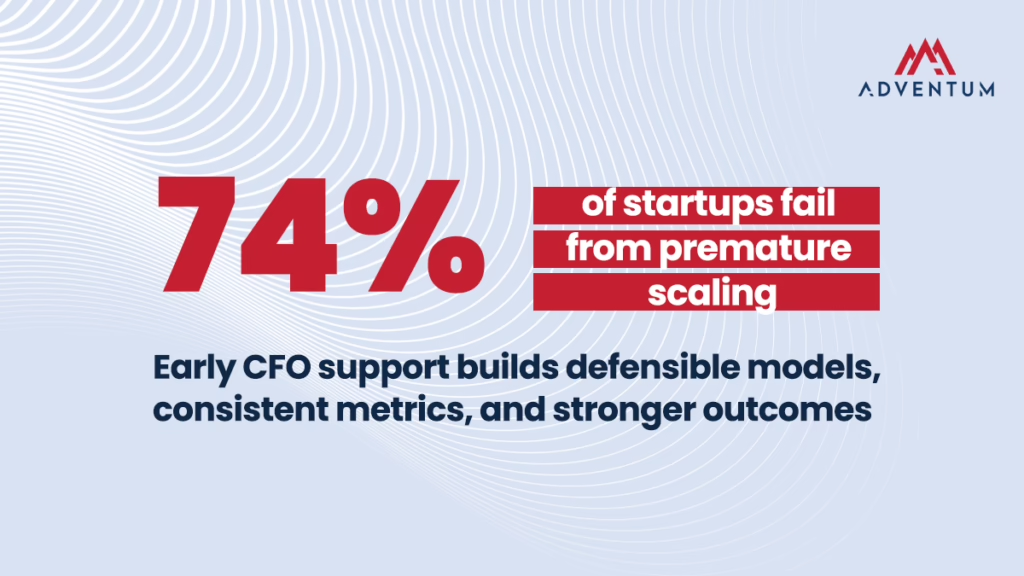
Knowing when to recommend CFO services to founders delivers an immediate advantage over competitors. With up to 74% of startups failing due to premature scaling, engaging CFO support early can build defensible models, maintain consistent metrics, and set the stage for long-term success.
Why Timing CFO Support Impacts Outcomes
The timing of CFO support has a direct, quantifiable impact on a company’s performance, particularly beyond Series B fundraising and during board-level decision-making. Strong financial leadership ensures consistent, defensible data fully support the company’s narrative.
Investors are ultimately underwriting a story, and that story must hold up under scrutiny. Where timing makes the biggest difference includes:
- Fundraising Performance: Aligning financials with the growth narrative strengthens credibility with investors.
- Data Defensibility: Ensures assumptions are consistent, supported, and easy to validate.
- Execution Readiness: Prepares the company for diligence before entering high-stakes conversations.
Valuation integrity is closely tied to how well a company’s financial assumptions hold up under scrutiny. Even strong growth can be discounted if the underlying model lacks clarity or consistency.
When assumptions are unclear or unsupported, investors introduce risk adjustments that reduce valuation. A well-structured financial model creates confidence, leading to stronger terms and smoother negotiations.
Board confidence operates similarly. When financials are innovative, straightforward, and aligned with strategy, board discussions stay focused on decision-making and growth.
5 Signals It’s Time to Recommend CFO Services to Founders
1. The Financial Model Doesn’t Hold Up Under Scrutiny
One of the earliest signals is a financial model that appears sound on the surface but quickly unravels under deeper questioning. Forecasts may shift with minor changes to assumptions, key drivers may be poorly defined, and sensitivity analysis is often either missing or overly simplistic.
These gaps are not always obvious internally, but they become immediately apparent during investor diligence.
From an investor’s perspective, this is a huge risk factor. A company’s valuation hinges on the credibility of its projections, and if the model cannot withstand scrutiny, the valuation cannot either. Recommending CFO services at this stage is about reinforcing the foundation before external pressure exposes the cracks.
2. Fundraising Preparation Is Reactive
Another sign is when fundraising preparation begins too late and unfolds reactively. Instead of a structured, intentional process, a company scrambles to assemble a data room, reconcile metrics across materials, and build a narrative while already in conversations with investors. This results in inconsistencies that create friction during diligence.
Reactive preparation demonstrates a lack of financial readiness, which investors interpret as execution risk. It suggests that the company is focused on presenting a story rather than building a durable one.
CFO support at this stage helps shift the approach to a proactive one, ensuring the financial narrative is fully cohesive before the fundraising process begins. In fact, proactive companies close rounds three to four weeks faster.
3. Board Meetings Are Becoming Translation Exercises
When board meetings start to feel like translation exercises, it is a strong sign that the finance function is not keeping up with the business. Founders may spend significant time explaining what the numbers mean rather than using them to drive strategic discussion. Board members, in turn, ask foundational questions that should already be addressed through clear reporting and analysis.
This dynamic introduces governance risk. When financial communication breaks down, decision-making slows, and confidence diminishes. Over time, this can create misalignment between leadership and the board. Recommending CFO services in this context is about restoring clarity and enabling more productive, forward-looking conversations.
4. Unit Economics Look Overly Optimistic
Overly clean or optimistic unit economics often indicate that deeper financial rigor is needed. Customer acquisition costs may exclude key expenses, margins may omit shared or indirect costs, and metrics may shift under diligence-level scrutiny.
While these issues are not always intentional, they create gaps between perceived and actual performance.
Investors tend to discount numbers that appear too good to be true, especially when they lack supporting detail. If unit economics do not hold up under examination, they won’t hold up in negotiations either. CFO support introduces the discipline needed to fully load costs, validate assumptions, and present metrics that are both accurate and defensible.
5. The Company Is Approaching an Inflection Point
Every stage of growth introduces new financial expectations, and companies that fail to anticipate these changes may struggle to keep up. Pre-Series A startups need to establish credibility; post-Series A companies must manage increasing operational complexity; and Series B funding and beyond require institutional-grade financial reporting and forecasting.
CFO support should be introduced ahead of these transitions. Waiting until after the inflection point increases the likelihood of missteps. Investors who recognize these situations early can guide founders toward the right level of financial infrastructure before it becomes a bottleneck.
Why Founders Delay CFO Support
Despite these signals, founders often delay bringing in CFO support due to a combination of misconceptions and practical concerns. Many believe that their existing accounting function is sufficient, assuming that accurate reporting alone is enough to support growth and fundraising. Others view CFO services as an unnecessary expense, particularly in pre- and post-seed stages when resources are tightly managed.
There is also a fundamental misunderstanding of what a CFO actually does. Accounting focuses on recording historical performance, while a CFO is responsible for shaping future outcomes through financial forecasting, planning, and strategic alignment. Reframing CFO services as decision infrastructure rather than overhead is critical to shifting this perspective.
What Changes When CFO Services Are Introduced Early
Before CFO support is introduced, finance often operates in a reactive mode, struggling to keep pace with business demands. This creates friction not only during fundraising but also in day-to-day decision-making.
Once CFO services are in place, the function is better built for the future and integrated with strategy. Financial models are built to withstand close examinations, assumptions are clearly defined, and the narrative is consistent across all investor-facing materials.
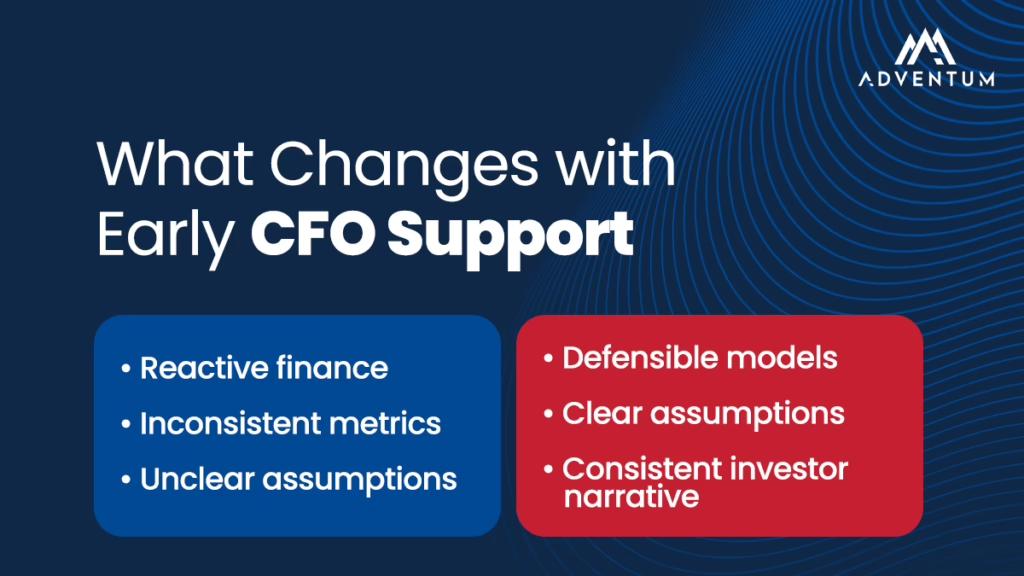
These changes transform finance from a source of risk into a source of leverage, enabling the company to operate with greater clarity and confidence.
How Investors Should Recommend CFO Services to Founders
When investors recommend CFO services to founders, the framing of the conversation is just as important as the recommendation itself. Positioning the decision as a cost or a role change rarely lands. Instead, it should be anchored in outcomes that directly shape the company’s trajectory and the investor’s return.
Rather than presenting CFO support as an added layer, shift the focus to what it enables in the near term. Founders are far more receptive when they can clearly see how it strengthens their position in the months ahead.
Focus the conversation on outcomes like:
- Fundraising Readiness: Ensuring financials, forecasts, and narratives are investor-grade before going to market
- Board Confidence: Improving clarity, reporting, and strategic alignment with stakeholders
- Valuation Protection: reducing risk factors that can lead to discounts during diligence
Use language that emphasizes tangible impact, such as:
- Building defensibility in fundraising conversations
- Creating resilience during investor diligence
- Increasing speed and confidence in decision-making
By grounding the recommendation in clear, outcome-driven benefits, investors can position CFO services not as a competitive advantage but as a way to help founders navigate critical inflection points with confidence.
The Cost of Waiting Too Long
The cost of delaying CFO support compounds over time, and the downstream impact is rarely isolated. Rather, it can affect multiple areas of the business at once.
Common consequences include:
- Lower Valuations: Uncertainty in financial assumptions can lead investors to apply discounts to valuations.
- Longer Fundraising Cycles: Inconsistencies and gaps take time to uncover and resolve.
- Increased Dilution: Weakened negotiating leverage often results in less favorable terms.
These effects are often interconnected, amplifying the overall impact and making recovery more difficult. Operational and governance challenges can also emerge:
- Strained Board Dynamics: Misalignment and reduced confidence can slow critical decisions.
- Limited Visibility: Financial gaps may go unnoticed as they gradually widen.
- Reactive Decision-Making: By the time issues surface, the window for proactive action has often closed.
Without timely CFO support, companies shift from shaping outcomes to managing consequences, often at a higher cost and with fewer options.
Timing CFO Support Is an Investor Advantage
Investors play a crucial role not just in allocating capital but also in influencing the timing of key decisions within a company. Knowing when to recommend CFO services to founders is part of that responsibility, as it directly affects how well the company navigates periods of growth, fundraising, and increased scrutiny.
CFO support protects the investment itself. When introduced at the right time, it strengthens valuation, enhances narrative control, and builds confidence across stakeholders. The earlier finance becomes a strategic function, the more effectively it can support long-term success.
Frequently Asked Questions About CFO Services for Startups
When should a startup hire a CFO?
A startup should bring in CFO support at key inflection points rather than waiting for a specific revenue milestone. These moments often include preparing for a fundraising round, scaling operations after initial traction, or managing increasing complexity in the financial model. From an investor perspective, the right time is before financial scrutiny intensifies, ensuring the company is fully prepared rather than reacting under pressure.
Do early-stage startups need a full-time CFO?
In most cases, early-stage startups do not require a full-time CFO. A fractional CFO provides the necessary strategic guidance and financial structure without the cost of a full-time executive. This approach allows companies to access high-level expertise while maintaining flexibility, making it a practical and widely adopted solution during the early stages of growth.
Why do investors recommend CFO services to founders?
Investors recommend CFO services to founders because of the direct impact on outcomes that drive returns. Strong financial leadership improves fundraising performance, strengthens the defensibility of financial models, and increases confidence at the board level. These factors collectively protect valuation and reduce the risk associated with execution and scaling.
What does a CFO do that accounting doesn’t?
Accounting functions focus on recording and organizing historical financial data to ensure accuracy and compliance. While this is essential, it does not address forward-looking needs. A CFO, by contrast, is responsible for forecasting, strategic planning, and aligning financial resources with growth objectives. This forward-looking perspective is what enables better decision-making and long-term planning.
How do CFO services impact fundraising outcomes?
CFO services play a critical role in shaping fundraising outcomes by ensuring that the financial narrative is clear, consistent, and aligned with the company’s strategy. They prepare the data room, validate key metrics such as ARR, CAC, and runway, and anticipate the questions that will arise during diligence. This preparation reduces friction, accelerates the process, and builds credibility with investors.
What are the signs a founder needs CFO support?
The signs that a founder needs CFO support are typically consistent across companies and stages. These include an unstable or unclear financial model, reactive fundraising preparation, board discussions that focus on clarifying numbers rather than making decisions, overly optimistic or inconsistent metrics, and the approach of a significant growth inflection point. Each of these signals indicates that finance is not keeping pace with the business and that proactive support is needed.