
Private equity interest validates your business model. But it’s not the same as due diligence readiness. PE due diligence exposes whether you have the financial infrastructure to close the deal. Companies that build investor-ready financial infrastructure before entering due diligence gain leverage to select the optimal partner and move quickly when strategic opportunities arise.
Private equity interest validates your business model. But it’s not the same as due diligence readiness. PE due diligence exposes whether you have the financial infrastructure to close the deal. Companies that build investor-ready financial infrastructure before entering due diligence gain leverage to select the optimal partner and move quickly when strategic opportunities arise.
The Inbound PE Problem
Ashok Kartham had built Mize from the ground up since 2012. The service lifecycle management platform was serving manufacturers across over 100 countries. Revenue was strong. And then the emails started coming private equity firms expressing interest.
Most founders would celebrate. Ashok realized something else: “Our success story needed to resonate with institutional investors.”
Translation: Having a successful business and being able to articulate success to institutional investors are two completely different capabilities.
This is the moment most growth-stage founders hit: Private equity interest validates your business model. But PE due diligence will expose whether you have the financial infrastructure to close the deal—and whether you have true due diligence readiness.
The Three Problems Inbound PE Interest Creates During Due Diligence
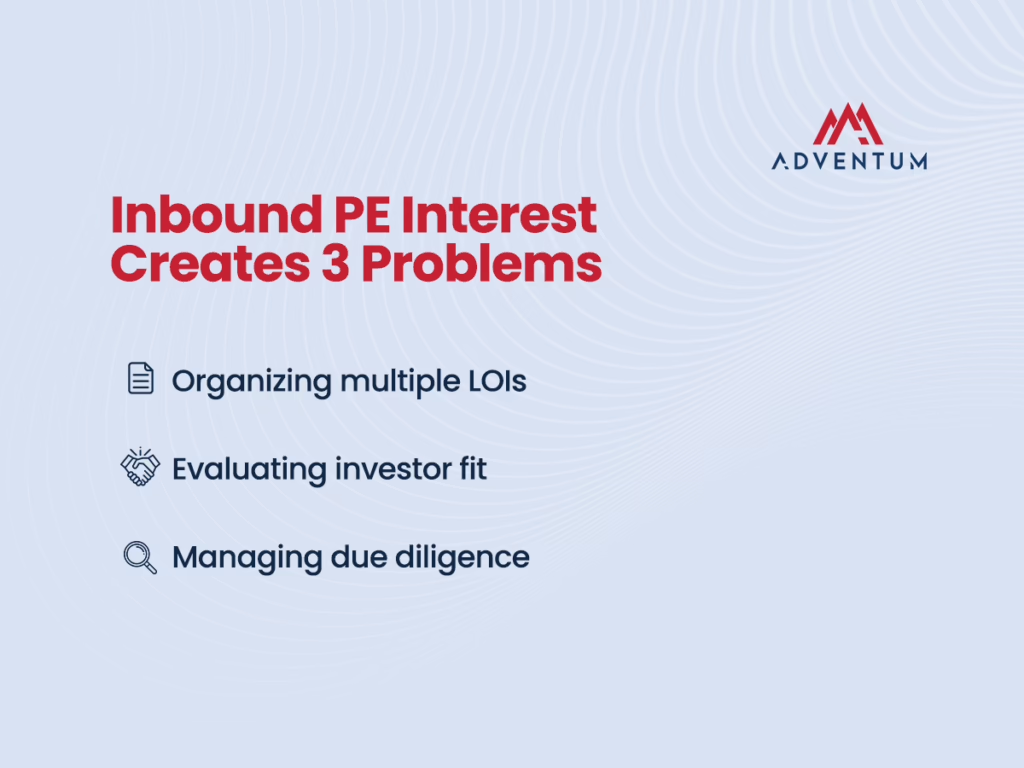
When Mize started receiving private equity inquiries, they faced three immediate challenges:
Organizing inbound leads — How do you evaluate multiple LOIs (Letters of Intent) when you’ve never run this process before?
Objective guidance for investor selection — Every PE firm will tell you they’re the right partner. How do you evaluate fit?
Support through the due diligence process — Institutional investors will scrutinize your financials at a level your accounting team has never experienced. Are you ready?
The companies that get this wrong pick the wrong partner, leave value on the table, or fail due diligence entirely.
The Information Asymmetry Problem in PE Negotiations
PE firms run this process 10-20 times per year. You’re running it for the first time, which is where gaps in due diligence readiness become visible.
That information asymmetry shows up in three ways:
Financial Model Sophistication
PE firms expect “transparent financials and structure” that demonstrate your “sound business model, growth trajectory, and ultimate long-term profit potential.” Can your accounting team produce the advanced modeling and scenario analysis that institutional investors expect during due diligence or build true board-level financial models that hold up under scrutiny?
Deal Structure Knowledge
PE firms know exactly which terms protect their interests. Do you know which terms are standard vs. which terms will constrain your future flexibility?
Due Diligence Speed
PE firms expect rapid responses to financial questions. If you’re building the model while they’re asking questions, you’re signaling that you’re not ready.
What Investor-Ready Financial Infrastructure Requires
When Mize engaged Adventum, the scope wasn’t “clean up the books”—it was build investor-ready financial infrastructure that increases confidence during due diligence, including a finance function that scales.
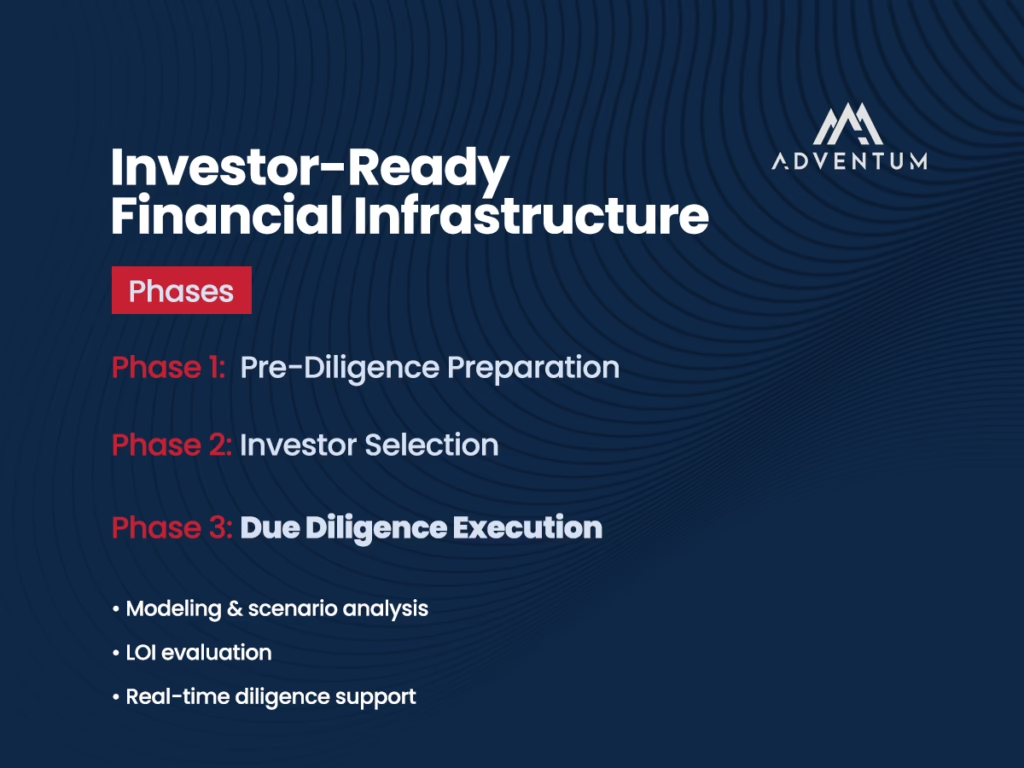
Phase 1: Pre-Diligence Preparation
Analyzed Mize’s financial structure alongside their internal accounting — Not replacing the accounting team, but building the future-forward financial model that PE firms expect
Built advanced modeling and scenario analysis — PE firms don’t invest in your base case; they invest when they understand your performance under multiple scenarios
Built advanced modeling and scenario analysis — PE firms don’t invest in your base case; they invest when they understand your performance under multiple scenarios, often requiring investor-ready financial models.
Phase 2: Investor Selection
Evaluated inbound Letters of Intent — Objective analysis of deal terms, firm fit, and value-add beyond capital
Provided objective recommendations to help select an investment partner — Helped Mize create a short list and choose M33 Growth (Boston)
Phase 3: Due Diligence
Championed due diligence and dynamic scenario analysis — Real-time financial modeling to answer investor questions, which “elevated trust”
Result: $15MM private equity investment from M33 Growth
How Pre-Deal Infrastructure Accelerates Strategic Exits
The financial infrastructure you build for PE due diligence is the same infrastructure that positions you for a strategic exit.
Mize’s timeline:
Year 1: PE due diligence → $15MM investment from M33
Year 2: Strategic buyer appears (Syncron AB, Swedish conglomerate)
Outcome: 3-4x multiple sale, swift return for both Mize and M33
Why the rapid exit? Adventum helped direct each phase of the Syncron AB merger/sale, from initial discussions through diligence and completion.
The financial model built for M33 became the foundation for the Syncron acquisition. Instead of rebuilding the infrastructure, Mize accelerated through diligence with a strategic buyer.
The pattern: Companies that build investor-ready financial infrastructure for PE deals are positioned to move quickly when strategic acquisition opportunities arise—similar to how companies prepare when preparing for later-stage fundraising.
When Growth-Stage Companies Need Investor Coordination
The need for investor coordination hits the moment you receive your first LOI and realize you can’t objectively evaluate it without someone who has seen hundreds of PE deals.
If you’re receiving PE interest and you’re asking:
“How do we evaluate which firm is the right partner?”
“Is our financial infrastructure ready for institutional due diligence?”
“How do we respond to financial questions we’ve never been asked before?”
…you’ve hit the investor coordination threshold and the point where private equity due diligence readiness becomes critical.
The Bottom Line for Growth-Stage Founders
Mize’s case shows the complete value proposition: Expansion → Investment → Exit
Expansion: Built the financial infrastructure for institutional scrutiny
Investment: Secured $15MM from M33 Growth
Exit: 3-4x multiple sale to Syncron AB the following year
The companies that maximize PE outcomes aren’t the ones with the best business models, they’re the ones that build investor-ready financial infrastructure before entering due diligence, giving them leverage to select the optimal partner and move quickly when strategic opportunities arise.
If you’re receiving PE interest, ask yourself: Can your current financial infrastructure answer every question a sophisticated PE firm will ask during due diligence—in real time?
If the answer is no, you’re entering negotiations without leverage.
FAQ: Private Equity Due Diligence for Growth-Stage Companies
What’s the difference between private equity interest and due diligence readiness?
PE interest means firms are contacting you. PE readiness means you have the financial infrastructure: transparent financials, advanced modeling, scenario analysis—to pass due diligence and negotiate from a position of strength.
What do private equity firms expect during the due diligence process?
PE firms expect transparent financials demonstrating your sound business model, growth trajectory, and long-term profit potential. They conduct advanced scenario analysis to understand performance under multiple conditions and expect rapid responses to financial questions.
How do you evaluate competing Letters of Intent?
Objective evaluation requires analyzing deal terms, firm fit, and value-add beyond capital. Companies without PE experience benefit from advisors who have evaluated hundreds of LOIs and know which terms are standard vs. red flags.
Why can’t I manage the PE process internally?
PE firms run this process 10-20 times per year; founders run it once. That information asymmetry affects financial model sophistication, deal structure knowledge, and due diligence speed. Investor coordination provides objective guidance at each decision point.
Can PE-ready infrastructure accelerate future exits?
Yes. Mize’s financial infrastructure built for M33 due diligence became the foundation for their Syncron AB acquisition the following year, enabling a swift 3-4x multiple return.
What did Mize’s engagement with Adventum deliver?
Adventum guided Mize through internal finance structure assessment, advanced modeling and scenario analysis, LOI evaluation, and due diligence support. Result: $15MM investment from M33 Growth. The following year, Adventum facilitated Mize’s sale to Syncron AB at a 3-4x multiple.
What does “investor coordination” include?
Investor coordination includes organizing inbound leads, providing objective guidance for investor selection, and supporting the company through the due diligence process—from financial modeling to deal structure analysis to real-time due diligence support.